SUMMARY
On Jaunuary 15 we disected a pig fetus. WE learned about the organs and got a Hands On experience on what the organs looked and felt like. We then had to do a work sheet on what the function of the organs were in the pig.
THOUGHTS AND OPINOINS
I thought that this was probably the highlight of the year for me. The pig disection was just so much fun and i also learned allot about how the body worked. But i thought we should have done the disection on a double block so we could have had a bit more time looking through the pig and looking at the organs. I cut off the head and that was pretty sweet!
ABOVE AND BEYOND
http://www.whitman.edu/biology/vpd/main.html
i put thisn one here so you could try out the pig disection if you might have missed it because its so sweet. but it wont be as fun as the real thing.
Wednesday, January 23, 2008

Thursday, January 17, 2008
January 15 blog- Eleanor McBain (Make up for another one) 3/3
January 15
Summary
Today in class, Mr. C. had all the kids paired in groups of 2 or 3 and had us prepare a lab that demonstrated the production of heat during excersize. So we had to:
-make a hypothesis ( if, then, because statement)
- design a procedure that would increase our body temperature
- Point out our variables (Manipulated, Controlled and Responding)
- tell how or why our body temp. increased
- Lastly, to make a conclusion, graph and table that illustrated our results within a group.
Thoughts and Opinions
Well Mr. C. I thought it was fun. My idea was to hop on one foot down the hall but the other ones didnt really want to.... Anyways. It was a fun activity to do and let us know why our body heat increased during activity.Some of the students just walked around the school for a while, and others actually took initiative and did something that was physically active. One of the students hopped around the class room for a bit, which was funny to watch.
To say the least, it was fun, worth-while, and educational.
Above and Beyond

Haha.. Anyways.
My additional insight is going to be a picture of the Gross anatomy.

Tuesday, January 15, 2008
January 14, 2008
January 14 Blog
Parker Konschuh ( Make-up for my last one) 3/3
Class Summary
- Began the muscle / motor system unit-
Three Main types of muscle tissue
- Cardiac: found in heart, involuntary (autonomic)
- Skeletal: moves bones, voluntary
- Smooth: found in organs, veins, arteries etc, involuntary
- Started looking more in depth with skeletal system
- Antagonistic pairs
- Muscle contraction (actin and miocin)
Thoughts on the Lesson
I thought the lesson gave a reasonable introduction to the motor system. For once I actually kinda understood what was going on during the first day. I dislike that we were assigned things with 10 minutes to go, but whatever. At least I could answer the questions. I think that the function of the muscle system is a little more obvious, and there will be less to do. I think that we will have to do some more work with muscle contractions before I understand the miocin / actin thing.
Above and Beyond
During this lesson I started to think of how going to the gym builds muscle strength. I didn’t really know how muscle fibre was produced or whatever makes you stronger. Mostly I was daydreaming and wondering what to put for above and beyond in my blog. Before finding this website I would have never guessed that this is how muscle growth occurred. So here it is:
Muscle fibre growth
Your muscles are made up of thousands of fibres called 'myofibres'. Lifting weights causes microscopic tears in the muscle fibres. Training actually breaks down the muscle.
Your body rebuilds the damaged fibres making them bigger and stronger. It does this to adapt to the stress of training. The next time you go to the gym, you'll be bigger and stronger. Your body can cope better, and so, less stress.
Many believe that muscle growth happens when they train. It is only between workouts, when we rest and feed the muscles that growth occurs.
How to increase muscle size.
We must train hard enough to damage the muscle fibres so our body rebuilds them bigger and stronger.
http://www.bodybuilding-for-beginners.com/muscle-growth.html
Parker Konschuh ( Make-up for my last one) 3/3
Class Summary
- Began the muscle / motor system unit-
Three Main types of muscle tissue
- Cardiac: found in heart, involuntary (autonomic)
- Skeletal: moves bones, voluntary
- Smooth: found in organs, veins, arteries etc, involuntary
- Started looking more in depth with skeletal system
- Antagonistic pairs
- Muscle contraction (actin and miocin)
Thoughts on the Lesson
I thought the lesson gave a reasonable introduction to the motor system. For once I actually kinda understood what was going on during the first day. I dislike that we were assigned things with 10 minutes to go, but whatever. At least I could answer the questions. I think that the function of the muscle system is a little more obvious, and there will be less to do. I think that we will have to do some more work with muscle contractions before I understand the miocin / actin thing.
Above and Beyond
During this lesson I started to think of how going to the gym builds muscle strength. I didn’t really know how muscle fibre was produced or whatever makes you stronger. Mostly I was daydreaming and wondering what to put for above and beyond in my blog. Before finding this website I would have never guessed that this is how muscle growth occurred. So here it is:
Muscle fibre growth
Your muscles are made up of thousands of fibres called 'myofibres'. Lifting weights causes microscopic tears in the muscle fibres. Training actually breaks down the muscle.
Your body rebuilds the damaged fibres making them bigger and stronger. It does this to adapt to the stress of training. The next time you go to the gym, you'll be bigger and stronger. Your body can cope better, and so, less stress.
Many believe that muscle growth happens when they train. It is only between workouts, when we rest and feed the muscles that growth occurs.
How to increase muscle size.
We must train hard enough to damage the muscle fibres so our body rebuilds them bigger and stronger.
http://www.bodybuilding-for-beginners.com/muscle-growth.html
Monday, January 7, 2008
Laura Smith Nov.19/07 2/3
Today in class we:
- Answered questions:
1) Which molecules carry energy from light reactions to dark?
2) Where does the Calvin Benson cycle happen?
- Marked the lab questions
- Went over photosynthesis practice questions
- Marked a photosynthesis diagram
- Looked at noncylclic photophosphorylation
- Got handed the "Candy Lab #2" sheet (will be doing it tomorrow)
- Watched a movie called "Cycle of Life" which was on photosynthesis
Thoughts and Questions:
I like studying photosynthesis because I find it pretty easy.
Where does the Calvin benson cycle happen?
Above and Beyond:
Where does the Calvin Benson cycle occur?
It occurs in the stroma of the chloroplasts.
Here is a picture that I found on google of the Calvin Benson Cycle

Tuesday, December 18, 2007
Cody Coleman Tuesday Dec.18/07 2/3
Reveiw of the day
Reveiwed worksheet {due thursday before the test}
Recaped overveiw of RS
Cilia overveiw
Looked at mechanism of breathing
Gas, transport, exchange in respiration
Questions
Opinions
Respiration is one of many amazing things that the bopdy does for you for free and you don't have to even work for it but really you because its your body. I find this unit kind of interesting but it is difficult to understand if you don't pay attention. The one thing i don't get is how your body can move the diaphram to create a sort of vaccum to carry air in and out of the body. I always thought you sucked air in on your own will.
Additional
I went on google.com and found so really interesting facts on respiration but i wont give them all to you because that would make people stop asking questions.
Reveiwed worksheet {due thursday before the test}
Recaped overveiw of RS
Cilia overveiw
Looked at mechanism of breathing
Gas, transport, exchange in respiration
Questions
Opinions
Respiration is one of many amazing things that the bopdy does for you for free and you don't have to even work for it but really you because its your body. I find this unit kind of interesting but it is difficult to understand if you don't pay attention. The one thing i don't get is how your body can move the diaphram to create a sort of vaccum to carry air in and out of the body. I always thought you sucked air in on your own will.
Additional
I went on google.com and found so really interesting facts on respiration but i wont give them all to you because that would make people stop asking questions.
- Central to the human respiratory system, they breathe in between 2,100 and 2,400 gallons (8,000 and 9,000 liters) of air each day—the amount needed to oxygenate the 2,400 gallons (9,000 liters) or so of blood that is pumped through the heart daily.
- An adults lungs cotain 600 million alveoli
Wednesday, December 12, 2007
December 7, 2007 Jessica Eddy 3/3
Class Review
- Got prepared for lab.
- Started lab for dissection of the heart.
Thoughts And Opinions
At first, the heart looked really disgusting!! It was full of fat and not what a heart was supposed to look like, well what I thought. It was really tough to get through, tougher than I thought. The muscles actually work I guess. It amazed me by how different the heart looked from the pictures that we got. It was completely different!! Overall, it was a fun class and I learned a lot from it.
Additional Insight
One of the first surgeons to use these improved techniques to gain access to the heart was Dr. Dwight Harken, a young U.S. Army surgeon. Many of Harken's patients were young soldiers evacuated from the European front with shell fragments and bullets lodged inside their hearts. To leave the shrapnel in was dangerous, but removing it was almost surely fatal. Harken began operating on animals, trying to develop a technique that would allow him to cut into the wall of a still beating heart, insert a finger, locate the shrapnel and remove it. All of his first 14 animals subjects died. Of the second group of 14, half died. Of the third group of 14, only 2 died. Harken felt ready to try the technique on humans. All of his patients survived, proving that the human heart could be operated upon.
It was very complicated to find all of the valves and parts of the heart when I did it on a sheep heart. I can't even imagine how hard it would be for a doctor to do an open heart surgery! Especially so long ago with no technology. That is impressive.

Tuesday, December 11, 2007
Kayleen Fahrlander Thursday Dec.6th 3/3
Class Summary
-Review heart sounds from last class
-Watch short movie clip (of a heart beating)
-Read pages 331-334 (exercise adjustment) and 338-339 (lymph system)
-Blood Assignment due Wednesday (Dec.12th)
**Homework**-Make labels for tomorrow's heart dissection (put tape over them)
Thoughts and Opinions
The more I think about the heart, the more grossed out I get about it. There are so many different parts and something could easily go wrong and stop your heart from beating. After going to bio class, I'm more aware of my heart beating and it makes me really uncomfortable. To me, this unit is a lot more interesting and useful than cellular respiration/ photosynthesis ever will be. I'm really excited about the heart dissection tomorrow!
Above and Beyond (Heart Facts)
-According to German researchers, the risk of heart attack is higher on Monday than any other day of the week.
-By the time you turn 70, your heart will have beat some two-and-a-half billion times (figuring on an average of 70 beats per minute.)
-Women's hearts beat faster than men's.
-Review heart sounds from last class
-Watch short movie clip (of a heart beating)
-Read pages 331-334 (exercise adjustment) and 338-339 (lymph system)
-Blood Assignment due Wednesday (Dec.12th)
**Homework**-Make labels for tomorrow's heart dissection (put tape over them)
Thoughts and Opinions
The more I think about the heart, the more grossed out I get about it. There are so many different parts and something could easily go wrong and stop your heart from beating. After going to bio class, I'm more aware of my heart beating and it makes me really uncomfortable. To me, this unit is a lot more interesting and useful than cellular respiration/ photosynthesis ever will be. I'm really excited about the heart dissection tomorrow!
Above and Beyond (Heart Facts)
-According to German researchers, the risk of heart attack is higher on Monday than any other day of the week.
-By the time you turn 70, your heart will have beat some two-and-a-half billion times (figuring on an average of 70 beats per minute.)
-Women's hearts beat faster than men's.
Sunday, December 2, 2007
Sarah Nov. 29 3/3
- 1st we went over the assignments from last day
-sandwich story
-thought lab
-jimmy digestion
-experiment
-started next section on circulatory system
-did notes
-got notes sheet
This class wasnt that bad. We didnt do a whole lot and i didnt have to worry about homework cause i had all my assignments done. So far the human body stuff sucks and theres a lot of dif things you need to know. Like we learnt the functions of the circulatory system
-waste removal/transport gas, nutrients
-immune system
-blood clotting/healing
-body temp
you need all these to be in homeostasis which is internal balance. Thast all we really learned which wasnt a whole lot so class wasnt all that bad.
http://hes.ucf.k12.pa.us/gclaypo/circulatorysys.html#AMAZING%20FACTS
This site claims to have amazing fact about the circulatory system. They're not that amazing but i though I'd share.
-One drop of blood contains a half a drop of plasma, 5 MILLION Red Blood Cells, 10 Thousand White Blood Cells and 250 Thousand Platelets.
-You have thousands of miles of blood vessels in your body. "Bill Nye the Science Guy" claims that you could wrap your blood vessels around the equator TWICE!
-Keep your heart healthy...it's going to have to beat about 3 BILLION times during your lifetime!
-sandwich story
-thought lab
-jimmy digestion
-experiment
-started next section on circulatory system
-did notes
-got notes sheet
This class wasnt that bad. We didnt do a whole lot and i didnt have to worry about homework cause i had all my assignments done. So far the human body stuff sucks and theres a lot of dif things you need to know. Like we learnt the functions of the circulatory system
-waste removal/transport gas, nutrients
-immune system
-blood clotting/healing
-body temp
you need all these to be in homeostasis which is internal balance. Thast all we really learned which wasnt a whole lot so class wasnt all that bad.
http://hes.ucf.k12.pa.us/gclaypo/circulatorysys.html#AMAZING%20FACTS
This site claims to have amazing fact about the circulatory system. They're not that amazing but i though I'd share.
-One drop of blood contains a half a drop of plasma, 5 MILLION Red Blood Cells, 10 Thousand White Blood Cells and 250 Thousand Platelets.
-You have thousands of miles of blood vessels in your body. "Bill Nye the Science Guy" claims that you could wrap your blood vessels around the equator TWICE!
-Keep your heart healthy...it's going to have to beat about 3 BILLION times during your lifetime!
Monday, November 26, 2007
Brianna Melcher, November 26, 3/3
Today in class we:

- Took some notes.
- Learned about the digestive system.
Thoughts and Opinions:
I think the digestive system could be important to learn if you wanted to be a doctor, but I find it boring and kind of pointless considering your body does it for you so why know how it works?
Above and Beyond:
Thursday, November 22, 2007
Memphis Vanbeselaere, November 20, 2007, 3/3
Today in class we:
I think this lab had great potential, although it seemed very unclear and confusing. It esspecially didn't help if you didn't understand the stages of photosynthesis to begin with. However once you got through the confusion I thought the lab helped me understand Photosynthesis a lot better.
Above and Beyond!
Here is an interesting video that explains photosynthesis. It's a tad bit more in depth than what we've learned but still a good video.
http://youtube.com/watch?v=Yy-8p1eZG4c&feature=related
Here is another video. It's kinda funny too, and the music is pretty hardcore. :D
http://youtube.com/watch?v=HrMka8vj73U&feature=related
- Did a lab, which involved making models with candy to represent the stages of Photosynthesis.
- Worked on review questions once we finished our lab.
I think this lab had great potential, although it seemed very unclear and confusing. It esspecially didn't help if you didn't understand the stages of photosynthesis to begin with. However once you got through the confusion I thought the lab helped me understand Photosynthesis a lot better.
Above and Beyond!
Here is an interesting video that explains photosynthesis. It's a tad bit more in depth than what we've learned but still a good video.
http://youtube.com/watch?v=Yy-8p1eZG4c&feature=related
Here is another video. It's kinda funny too, and the music is pretty hardcore. :D
http://youtube.com/watch?v=HrMka8vj73U&feature=related
Rebekah O'Brien, Nov. 22/07

what we did:
- finished the nutrients worksheet (carbohydrates/ lipids/ proteins)
- looked at enzymes
- took notes from the board (section 8.2, pg. 254-258)
- went over questions on pg. 258, #1, 3, 11 a) b) c)
- got a digestive system handout
- started taking 1st page of handout notes
- the material covered was all pretty straightforward, but i wondered how many amino acids are there in a protein?
- but i'm not looking forward to the PS and CR UNIT TEST tomorrow!!!
- apparently there are about 288 amino acids in one average sized protein molecule!

Wednesday, November 21, 2007
Christina Rose: Monday November 20th, 2007: 3/3
What we did in class today...
I think the lab was a good idea. it helped us see photosynthesis visually, and helped us figure out what we know and need to know. The only part that I didn't like was that it was a completely open ended lab. You had to figure out every last detail your self with out aid.
Above and Beyond...
A overview of photosynthesis.

- Spent two blocks recreating photosynthesis with candy.
- Worked on review questions.
Thoughts and Opinions...
I think the lab was a good idea. it helped us see photosynthesis visually, and helped us figure out what we know and need to know. The only part that I didn't like was that it was a completely open ended lab. You had to figure out every last detail your self with out aid.
Above and Beyond...
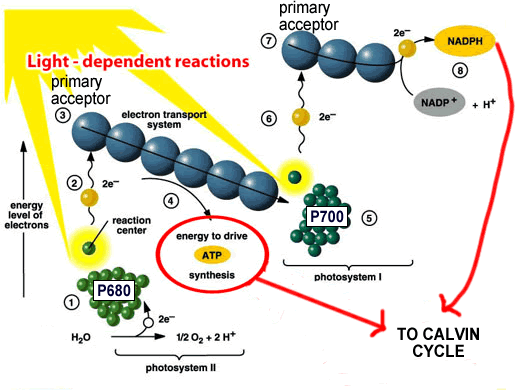
A overview of photosynthesis.

The Calvin- Benson Cycle.

Light Dependent Reactions.

Tuesday, November 20, 2007
Tane Stange Friday November 16th, 2007 3/3
What we did in class today...
- Pre-Lab Quiz
- Seperating plant pigments from leaves Lab
Thoughts ad Opinions
Last night we had to read about the lab, and get an idea of what we were doing in the lab for Friday. The pre-lab quiz was useful because we were supposed to already know what we are doing in the lab, but for those who didn't go over the procedure still had an idea from when we marked the quiz. The lab itself was simple, enough that we got started and completed it in the time provided. I was suprised that it worked, and we could see that the pigments clearly seperated on the chromatography paper. The only uncontrolled variables that would alter the results slightly were the amount of spinach pressed on the paper, and the amount of solution used in the test tube. Other than that, this lab was easy, and effective.
Above And Beyond
Like Dylan, I found a cheezy video on u tube, but on photosynthesis instead of Cellular Respiration. The video is brief, but does explain the light dependent reactions we are learning about.
Kat Vanderzwan - Nov. 15/2007 - 3/3
What we did:
- Kyle drew a picture of a plant cell on the board, and a picture of a chloroplast. We went over his drawing and reviewed most of the stuff we learned about chloroplasts in grade 10.
- We talked about the thylakoid, grana, stroma and chlorophyll. The thylakoids are the site of "light independant" reactions of photosynthesis. Stacks of thylakoids form the grana, and the grana are connected by stroma.
- We also talked about light and dark reactions. Light reactions or light dependant reactions convert sunlight into chemical energy. Dark reactions or light independant reactions require the products of light reactions, they take them and preform further chemical processes on them. There is two dark reactions The Calvin-Benson Cycle and carbon fixation.
- We watched a short movie on photosynthesis.
Thoughts and Opinions
We had a double block today and those usually go pretty slowly, and so now that I think back to it I have a hard time differenciating between the two classes. I think that today was useful in reminding us what we already know, but at the same time a little bit tedious because we already knew some of the stuff. Today was a slow class because some of it was review, but I was a little suprised at how much kids in the class forgot from last year. We did learn some new stuff today, but I'm doing this like 5 days later so I'm having a hard time remembering and I might have added stuff that we learned on Friday, Monday or Tuesday. Oh well. Personally I think that this topic is pretty interesting and I wonder why someone looked at a plant and was like "I WONDER WHY IT'S GREEN!?" because it seems like one of those things that just are, y'know? But who knew that there was so much stuff to it? Photosynthesis is pretty complex.
Above and Beyond
here is a song i found about photosynthesis, im pretty sure that we're at a deeper level then this song is. but hey, it's a good time!
http://youtube.com/watch?v=PIvn7b4LbMc&feature=related
Wednesday, November 7, 2007
Dylan Webster - Nov 6, 2007 3/3
What we did?
- took some notes on cellular respiration
- reviewed the 4 stages of C.R many times
- looked at how ATP was formed handout
What I think?
- I find it really confusing and I don't really see the point of learning about cellular respiration because I don't have to do it my body does it for me, which is great. I can't imagine having to do C.R myself, I would most likely be dead guy.
Above & Beyond
- when i think about the "great" topic of cellular respiration i can't stop to think....is there an easier way, i did some research and the answer is no! So i thought I would just talk about some interesting facts about C.R...oh dang there arn't any but I did find a cool cellular respiration song at: http://www.youtube.com/watch?v=fmyby8zWeSU
I can't believe someone made a song about cellular respiration...haha
Monday, November 5, 2007
Auddy Alekna-November.05/2007-3/3
What we did:
What we did:
- Marked Cellular respiration sheets from friday.
- Took some notes and review.
- Went over the ATP formula sheets
Thoughts and Opinions
The class was kinda slow. we didnt get any homework or anything today. dont really see how this is something that we need to know for a career unless you want to be a genetic scientist.
Above and Beyond
Through the class the use of glycose in our body and where our body gets them from (simple glucose, complex glucose, fat, and eventually protein). From this I wondered (as creepy as it may seem) how long would it take for the body, without food to finally resort to eating its own protein? Here was what i found http://www.goaskalice.columbia.edu/1340.html.
Friday, November 2, 2007
Cody Coleman- October 30.2007 2/3
Finished quiz on evloution
Marked quiz
reviewed for unit test on wednesday with a Jeopardy game
Evolution is an amazing thing to learn about and with every turn there is something new and exciting to find. You never know what will happen.
Remember to Study for your exam on october 31. 2007 and have your worksheet done so you can write it.
Marked quiz
reviewed for unit test on wednesday with a Jeopardy game
Evolution is an amazing thing to learn about and with every turn there is something new and exciting to find. You never know what will happen.
Remember to Study for your exam on october 31. 2007 and have your worksheet done so you can write it.
Monday, October 22, 2007
Jessica Eddy October 22, 2007 3/3
Class Review:
- Handed in late Bio Field Projects.
- Marked homework.
- Learned about embryos, homologous and analogous features, vestigial features and similarities/differences in DNA.
- Did Analysis assignment.
- Went through and took notes on "Early Beliefs about Evolution" handout.
Thoughts and Opinions:
Its crazy to think that all of the evidence that we base our evolution and scientific history on is as much as we could fit in the back of a pickup truck. I had never thought of it that way and it amazed me. Its interesting how closely related some species are to others. For example, the T-Rex and the chicken. It was hard to picture that image in my head. Overall, it was an interesting class and I learned a lot of new information. I'm just wondering, what species humans are the closest to?
Additional Insight
http://www.amnh.org/exhibitions/permanent/humanorigins/past/dna.php
The chimpanzee and another ape, the bonobo, are humans' closest living relatives. These three species look alike in many ways, both in body and behavior. But for a clear understanding of how closely they are related, scientists compare their DNA, an essential molecule that's the instruction manual for building each species. Humans and chimps share a surprising 98.8 percent of their DNA.
The light and dark bands on these chromosomes, created by a laboratory dye, reveal similarities and differences among human, chimp and mouse DNA.
- Handed in late Bio Field Projects.
- Marked homework.
- Learned about embryos, homologous and analogous features, vestigial features and similarities/differences in DNA.
- Did Analysis assignment.
- Went through and took notes on "Early Beliefs about Evolution" handout.
Thoughts and Opinions:
Its crazy to think that all of the evidence that we base our evolution and scientific history on is as much as we could fit in the back of a pickup truck. I had never thought of it that way and it amazed me. Its interesting how closely related some species are to others. For example, the T-Rex and the chicken. It was hard to picture that image in my head. Overall, it was an interesting class and I learned a lot of new information. I'm just wondering, what species humans are the closest to?
Additional Insight
http://www.amnh.org/exhibitions/permanent/humanorigins/past/dna.php
The chimpanzee and another ape, the bonobo, are humans' closest living relatives. These three species look alike in many ways, both in body and behavior. But for a clear understanding of how closely they are related, scientists compare their DNA, an essential molecule that's the instruction manual for building each species. Humans and chimps share a surprising 98.8 percent of their DNA.
The light and dark bands on these chromosomes, created by a laboratory dye, reveal similarities and differences among human, chimp and mouse DNA.

Kayleen Fahrlander Friday 19th 3/3
Class Summary
-Hand in quadrat projects
-Take notes from over head on 1st hand out (fossils/evolution)
-Do questions on 2nd hand out (fossils/evolution)
Thoughts/Opinions
- Evolution is such an abstract concept because it's hard to imagine that every living thing may have come from a single one-celled organism.
-Many people may be skeptical of evolution because of religous beliefs, but there is serious evidence (through the study of DNA bases) that proves that some organisms are closer related than we think.
Above and Beyond
Oldest Fossil Ever Found-A team of Swiss and Austrian geologists found some 3.45 billion-year-old dolomite in the Pilbara range in North West Australia. After etching it with acid they found the fossils using an electron microscope.
It is believed that the fossils are of a cyanobacteria - an organism that still forms thick mats in warm shallow seas today.
In the early pre-Cambrian period, they played a vital role in the development of more complex species by being among the first life forms to use sunlight to help them absorb carbon dioxide and release oxygen and therefore making the atmosphere breathable.
-Hand in quadrat projects
-Take notes from over head on 1st hand out (fossils/evolution)
-Do questions on 2nd hand out (fossils/evolution)
Thoughts/Opinions
- Evolution is such an abstract concept because it's hard to imagine that every living thing may have come from a single one-celled organism.
-Many people may be skeptical of evolution because of religous beliefs, but there is serious evidence (through the study of DNA bases) that proves that some organisms are closer related than we think.
Above and Beyond
Oldest Fossil Ever Found-A team of Swiss and Austrian geologists found some 3.45 billion-year-old dolomite in the Pilbara range in North West Australia. After etching it with acid they found the fossils using an electron microscope.
It is believed that the fossils are of a cyanobacteria - an organism that still forms thick mats in warm shallow seas today.
In the early pre-Cambrian period, they played a vital role in the development of more complex species by being among the first life forms to use sunlight to help them absorb carbon dioxide and release oxygen and therefore making the atmosphere breathable.
Thursday, October 18, 2007
Kyle hinchcliffe oct.18/07
Today we learned about evolution . the kingdoms of certain species .
I think this class is super fun :). The topics we discuss are fun and educational.
I have no questions
I think this class is super fun :). The topics we discuss are fun and educational.
I have no questions
Subscribe to:
Posts (Atom)